Guides / Materials
4130 or 4140 Chromoly: Which Steel for a Machined Car Part
October 12, 2026
4130 and 4140 are close relatives. Both are low alloy steels with chromium and molybdenum, sold as “chromoly”, and a shop will often have both in stock. People swap the names casually, but the two behave differently in a few ways that matter on a car.
This guide compares them and says which one fits which part.
What the numbers in the name mean
Both belong to the 41xx family of steels. The first two digits mark the alloy group, chromium and molybdenum. The last two digits give the carbon content in hundredths of a percent.
- 4130 has about 0.30 percent carbon.
- 4140 has about 0.40 percent carbon.
Both carry roughly 0.8 to 1.1 percent chromium and 0.15 to 0.25 percent molybdenum. The difference is carbon, and carbon is what sets hardenability and weldability.
Side by side
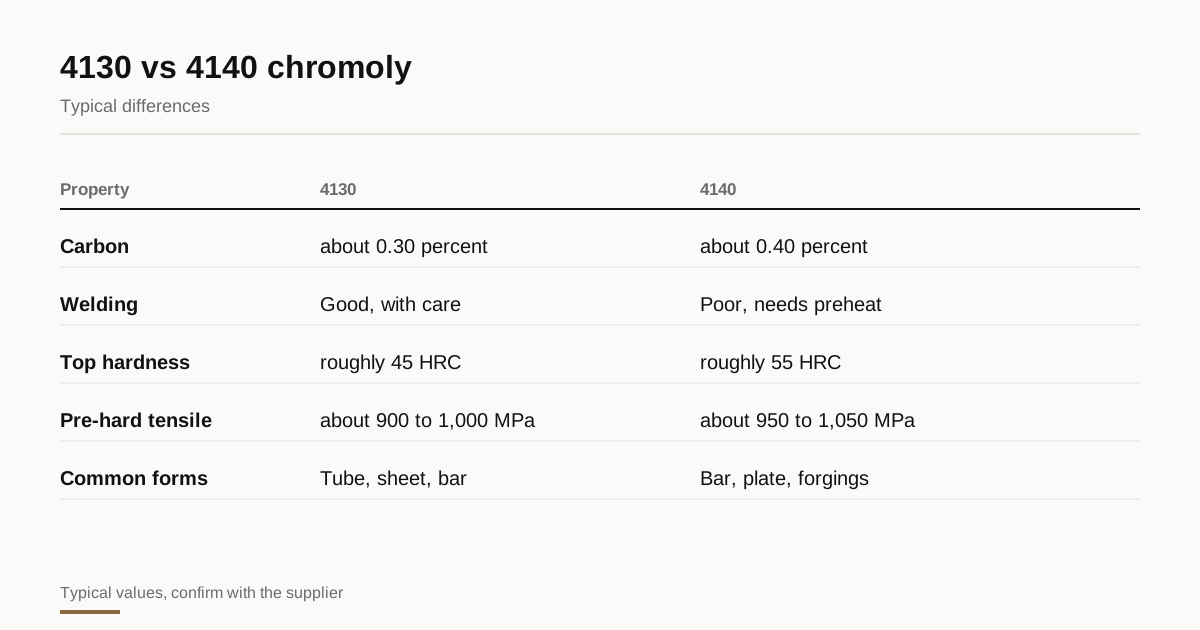
| Property | 4130 | 4140 |
|---|---|---|
| Carbon | about 0.30 percent | about 0.40 percent |
| Tensile strength, normalized or annealed | about 560 to 670 MPa | about 650 to 750 MPa |
| Tensile strength, pre-hardened 28 to 32 HRC | about 900 to 1,000 MPa | about 950 to 1,050 MPa |
| Highest practical hardness after quench and temper | roughly 45 HRC | roughly 55 HRC |
| Welding | Good, with care | Poor, needs preheat and stress relief |
| Machinability | Good | Good, slightly harder on tools when pre-hardened |
| Common forms | Seamless tube, sheet, bar | Bar, plate, forged blanks |
Values are typical, and the actual numbers depend on the supplier, the section and the treatment. Check the mill certificate.
Why weldability matters on a car
Chromoly became famous in roll cages, chassis frames and suspension links because of 4130. It welds well, with TIG and a suitable filler, and the heat affected zone stays tough when the joint is done correctly. Thicker sections call for preheat, and many builders stress relieve.
4140 has more carbon, so the heat affected zone hardens during cooling and can crack. It is not impossible to weld, but it needs preheat, slow cooling and often post weld heat treatment. For a part that a fabricator will weld, 4130 is the safe choice.
Where each one earns its place
4130 fits:
- Chassis and cage tube
- Suspension links and control arms that are welded from tube and plate
- Brackets and mounts that get welded to a frame
- Fabricated steering and pedal parts
4140 fits:
- Drive shafts, axle shafts and stub axles
- Hubs, spindles and flanges machined from solid
- Gear blanks and splined parts, either through hardened or case hardened with a nitride
- Studs, bolts and pins above about 150 ksi tensile where the thread is rolled after heat treatment
- Crank and rod forgings for high output engines, depending on the forging grade
In a machined part with no welding, 4140 is often the better choice because it reaches higher strength, and it is widely stocked in round bar.
Heat treatment
Both respond to quench and temper. A part is rough machined, heated to about 845 C, quenched in oil or polymer, then tempered at a temperature that sets the final hardness.
4140 hardens deeper, so a large section gets a strong core. 4130 has lower hardenability, so a section over about 25 mm may not harden all the way through.
Many shops buy 4140 in the “pre-hard” condition, at around 28 to 32 HRC. It can be machined directly without a further heat treatment and delivers around 1,000 MPa tensile. For a bracket or a hub that needs a bit more than aluminum can give, that saves a step. For more on how steel is hardened in practice, read through hardening vs case hardening.
Machining
Both machine well when annealed or pre-hardened at about 30 HRC. At that hardness, expect to use carbide tooling and moderate speeds. Above about 40 HRC, machining gets slow and grinding or hard turning takes over.
Machining after hardening is slower and costs more. If your part needs a thread or a close bore, tell the shop whether you want it finished before or after heat treatment, and see the notes on distortion in the heat treatment guide.
Stock forms and cost
4130 is common as seamless tube (often under ASTM A519 or an aerospace tube spec), sheet and bar. 4140 is common as hot rolled and cold finished bar and as plate, and it is the usual choice for large round bar.
Prices per kilogram are similar. The bigger difference comes from the form. A tube part made from 4130 tube costs less than the same part turned from 4140 bar, because most of the bar would be chips.
Corrosion and finish
Neither grade is stainless. A bare chromoly part rusts quickly in a wet climate.
- Black oxide with oil gives a light, thin finish, adds almost nothing in size and is common on shafts and fasteners.
- Zinc or zinc nickel plating gives better protection. Parts above about 39 HRC need baking after plating to drive out hydrogen.
- Paint or powder coat works for brackets and frames and adds thickness that you must allow for.
State the finish on the drawing and say whether dimensions apply before or after.
Specifying the steel
Write the grade, the condition and the standard, for example:
“4140 steel bar, ASTM A29, pre-hardened 28 to 32 HRC, with mill certificate”
or
“4130 seamless tube, ASTM A519, normalized, with mill certificate”
A drawing that just says “chromoly” leaves it to the shop to guess. A shop may quote 4140 because it has it, even if your part is going to be welded.
If you need the material certificate to follow the part, say so in the quote request. It costs little at the time and cannot be recreated later.
A decision rule
- Will the part be welded? Use 4130.
- Is it machined from solid, with high strength or wear needs? Use 4140.
- Does it need hardening beyond about 45 HRC? Use 4140.
- Is weight critical in a tubular structure? Use 4130 tube.
- Unsure? Tell the shop what the part does and what load it sees, and ask.
Common mistakes
Asking for “chromoly” with no grade. The shop picks whichever bar it has on the rack. If the part will be welded, that choice can be the wrong one.
Welding a pre-hardened 4140 part without a plan. The weld zone cracks or stays brittle. If a tab must be added later, design it as a bolted joint instead.
Forgetting the finish. A bare chromoly bracket left in a garage rusts in weeks. Decide on black oxide, plating or paint before the order, since each one changes size or hardness limits.
Treating pre-hard bar as fully hardened. Pre-hardened 4140 at about 30 HRC is strong and tough, but it is not a wear surface. Splines and bearing journals still need a case or a nitrided skin.
Questions to ask the shop
- Which grade and condition do you have in stock for this size?
- Will the part be cut from bar, plate or a forged blank?
- Is the material certificate included, and does it list the heat number?
- If heat treatment is needed, who does it and what hardness do you report?
- Which surfaces get finished after treatment?
Clear answers to these tell you the shop has handled chromoly before.
Next step
Send the drawing with the grade, the condition and the finish you want. If you are unsure between steel and aluminum, see 6061 vs 7075 for brackets. Send the request and we match it with up to 3 shops, with a reply within 24 business hours.
For the full process, read the buyer’s guide.
Frequently asked questions
Is 4130 stronger than 4140?
Not at the same heat treatment. 4140 has more carbon, so it reaches a higher hardness and strength when quenched and tempered. 4130 gives up some strength in exchange for much easier welding. For a part that is welded, 4130 is the normal choice.
Can I weld 4140?
It can be done but needs preheat, controlled cooling and often a stress relief afterwards, because the higher carbon makes the heat affected zone prone to cracking. Most builders avoid welding 4140 and design the part to be bolted or machined from one piece.
Do chromoly parts need a coating?
Yes. Both grades rust. Common finishes are black oxide with oil, zinc based plating with a bake for hydrogen, paint or powder coat. Say which one you want, since it changes tolerances and hardness limits.
Need a quote for this part?
Send the drawing or photos of the old part. We match you with up to 3 shops and reply within 24 business hours.
Get matched with a CNC shop