Guides / Process
Bearing Bore Tolerance in Automotive Parts: Press Fits That Hold
October 22, 2026
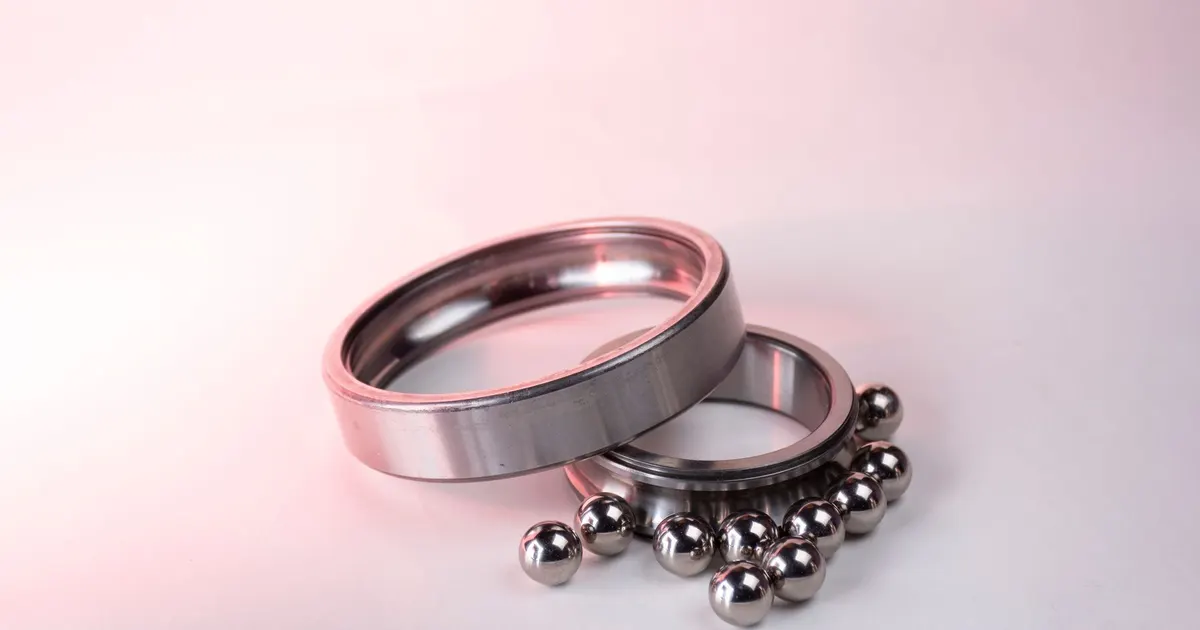
A bearing is only as accurate as the hole it sits in. If that hole is out of round, oversize, tapered or too rough, the bearing runs hot, wears early or spins in its seat. On a machined automotive part the bearing bore is often the most important dimension, and it is easy to specify badly.
This guide covers the fit classes, the aluminum problem, finish and inspection.
Why the fit matters
A ball or roller bearing carries load through thin rings. The outer ring needs to be supported around its full circumference. If the housing is too loose, the ring can creep, which is a slow rotation that wears the bore and heats it. If the housing is too tight, the ring is squeezed out of round and the internal clearance disappears, so the bearing runs hot and noisy.
The right fit holds the ring without distorting it. The word “press fit” covers a range, from a light push to something that needs a press and sometimes heat.
ISO fit classes on a common size
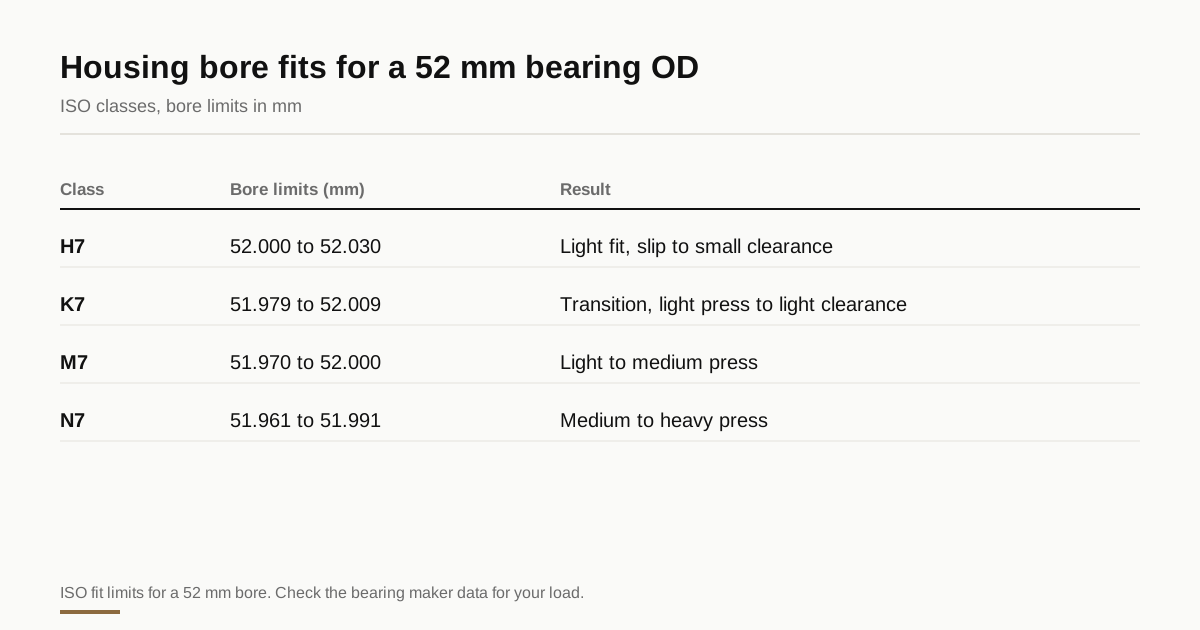
For an example, take a deep groove bearing with a 52 mm outside diameter, such as a 6205. The bearing’s outer ring tolerance is about 0 to minus 0.013 mm. Housing bores in common ISO classes have these limits:
| Class | Bore limits (mm) | Result with the bearing |
|---|---|---|
| H7 | 52.000 to 52.030 | Light fit, slip to a small clearance |
| K7 | 51.979 to 52.009 | Transition, light press to light clearance |
| M7 | 51.970 to 52.000 | Light to medium press |
| N7 | 51.961 to 51.991 | Medium to heavy press |
Treat the table as a guide. It is the standard ISO fit system, but the right choice for your application depends on the bearing maker’s data for load, speed, direction of load and housing material.
The aluminum problem
Most billet automotive housings are aluminum, and aluminum expands about twice as much as steel for each degree of temperature rise. A bore that is a tight fit with a steel bearing at 20 C can lose its interference once the housing reaches 80 to 100 C near an engine or a gearbox.
The result is a bearing that creeps in its seat. You hear it as a whine, then see fretting marks, then the bore wears oversize.
There are four ways to deal with it.
- Tighter fit class. Move from K7 toward M7 or N7 for an aluminum housing, so some interference remains when hot.
- A shoulder and a retaining ring. A shoulder on one side and a snap ring on the other stop axial movement, but they do not stop rotation.
- Retaining compound. A thin film locks the ring and fills small gaps. It is common and effective for a mild loss.
- A steel sleeve or insert. A pressed or bonded steel liner gives the bearing a steel seat and removes the thermal difference.
If you are unsure which applies, tell the shop the operating temperature and the housing material.
Roundness and cylindricity
A bore that measures right at one point but is out of round is still wrong. A bearing ring will conform to the shape of the bore, so an oval bore makes an oval ring.
Geometric tolerances help. Roundness and cylindricity within about one third to one half of the size tolerance are common requirements. On a 52 mm H7 bore (30 micrometers wide) that means a roundness tolerance in the range of 10 to 15 micrometers.
Boring and then finish reaming or honing is the usual route to hold this. A single bore made with an end mill is rarely round enough for a bearing seat.
Finish and edges
The bore surface should be smooth and free of chatter. Around 0.8 to 1.6 µm Ra is a typical target for a bearing seat. A rough bore flattens under load, and the fit loosens as the peaks wear.
The edges matter too.
- Entry chamfer. A chamfer of about 0.5 mm at 15 to 30 degrees on the bore edge helps start the bearing straight and avoids shaving aluminum.
- Shoulder radius. The corner at the bottom of the bore should be smaller than the bearing corner radius, or the bearing will not seat. Check the bearing’s maximum corner radius in its data sheet.
- Burrs. Remove them. A burr at the bore entry shaves metal as the bearing goes in and contaminates the fit.
Temperature when you measure
Aluminum changes size with temperature, and so does the gauge. A bore measured warm from the machine reads different from the same bore at 20 C. The standard reference temperature for dimensional measurement is 20 C, and good shops let a part stabilize before checking critical bores.
If the shop measures straight off the machine, ask what they allow for. The difference on a 52 mm aluminum bore is a few micrometers for each few degrees, which is a large part of a 30 micrometer tolerance.
How a bore is inspected
Three methods are common.
- Bore gauge. A dial or digital bore gauge set from a ring gauge reads the diameter in two directions and at two depths. Good for in process checks.
- Air gauge. Fast, accurate and gentle on soft metal. Often used on production work.
- CMM. A coordinate measuring machine can measure roundness, cylindricity and position relative to other features.
For a one off part, a good bore gauge and a ring gauge is enough. For a part with several bores that must be in line, ask for a CMM report of the bore positions as well as the sizes.
Press fit assembly tips
- Press on the ring that carries the fit. For a housing fit, push on the outer ring only, never through the balls.
- Use a tool that matches the outer ring diameter and keep it square.
- Warm the aluminum housing to a moderate temperature, which opens the bore for a few moments, and freeze the bearing if needed. Follow the bearing maker’s limits on heat.
- A light film of oil reduces galling, unless you are using retaining compound, in which case follow its instructions.
What to put on the drawing
- Bore diameter and ISO class, such as “52 H7”.
- Roundness and cylindricity.
- Surface finish.
- Entry chamfer and shoulder radius.
- Depth and position relative to the other datums.
- Housing material and operating temperature.
If you only know the bearing number, give the bearing number. A shop can look up the outside diameter and suggest a class, but you should confirm it against your use.
Common mistakes
Specifying a tolerance with no class. “52 plus or minus 0.01” leaves the shop guessing whether you want a loose or a tight fit. Use the ISO class or a clear upper and lower limit.
Forgetting the coating. Anodizing grows a bore inward by a few micrometers on each side. On a tight press fit that can be the difference between pushing a bearing in by hand and needing a press. Say whether the size applies before or after the finish.
Boring with an end mill. A single milled bore is rarely round enough. Ask for a bored and reamed or honed bore on any bearing seat.
Reusing a bearing seat that has already spun. A bore that has worn oversize does not recover with retaining compound for long. Sleeve it or make a new part.
Measuring warm. A bore measured straight off the machine reads wrong once the part cools.
Questions to ask the shop
- Will the bearing bores be cut in one setup, so they stay in line?
- How do you measure the bore, and at what temperature?
- Can you report roundness as well as diameter?
Next step
Send the drawing with the bearing part number, the housing material and the operating temperature. Send the request and we match it with up to 3 shops, with a reply within 24 business hours.
Related reading: what a shop needs to quote, 6061 vs 7075 for brackets and the buyer’s guide.
Frequently asked questions
What tolerance should I put on a bearing bore?
For a typical sealed deep groove bearing in a steel housing, H7 or K7 is the common starting point. In an aluminum housing, a tighter class such as M7 or N7 is often used because aluminum expands more than steel when warm. Check the bearing maker's fit tables for your load and speed.
Why does a bearing spin in an aluminum housing when it is hot?
Aluminum grows nearly twice as much as steel for the same temperature rise. A fit that is snug at room temperature can lose its interference once the housing warms up, and the bearing outer ring starts to creep. A heavier fit, a shoulder, a circlip or retaining compound solves it.
Can I fix a loose bore with retaining compound?
It helps a mildly loose fit and is common on repair work, but it is not a substitute for the right tolerance. If the bore is oversize by more than a few hundredths of a millimeter, make a sleeve or a new part.
Need a quote for this part?
Send the drawing or photos of the old part. We match you with up to 3 shops and reply within 24 business hours.
Get matched with a CNC shop