Guides / Buying Guide
Billet Differential Cover Machining: What to Specify for Rear End Parts
October 25, 2026
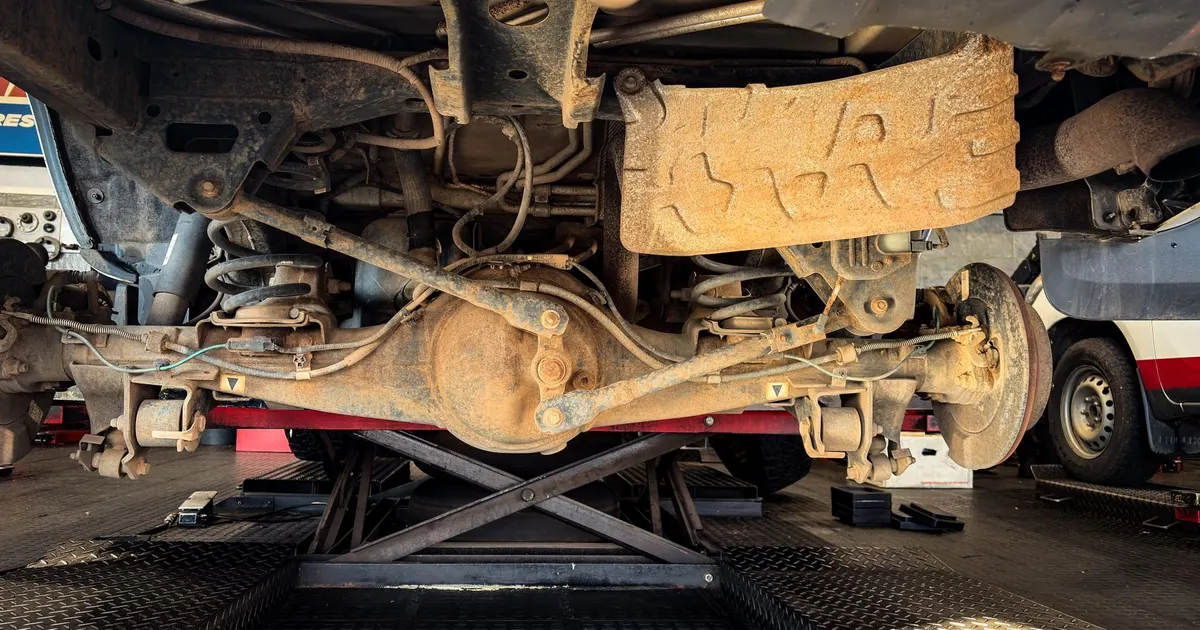
The differential cover closes the back of the axle housing. On a stock car it is a stamped steel plate with a gasket. On a performance or heavy duty build, a billet cover adds strength, oil capacity, cooling fins and a good look. It also becomes a part that must fit a housing to a tight tolerance, hold oil and in some designs support the internal parts of the differential.
This guide covers what to specify when you order a cover or another billet rear end part.
What a cover does
- Seals the housing and keeps gear oil in.
- Gives access to the gears for service and for setting backlash.
- Provides fill and drain ports, and sometimes a vent and a magnet.
- Adds oil volume and cooling area, in finned designs.
- Braces the housing, on covers made with a thick section and many bolts.
- Supports the bearing caps, in covers with built in girdle supports.
Mating features
The cover has to match the housing opening.
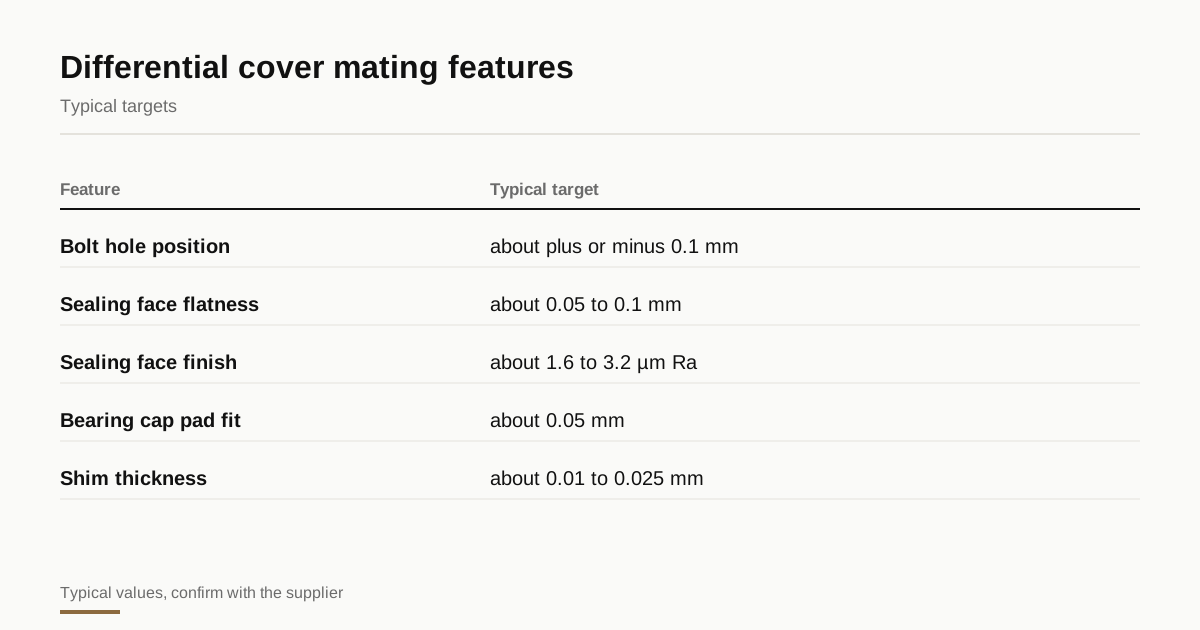
| Feature | Typical target |
|---|---|
| Bolt pattern | Match the housing exactly, hole position about plus or minus 0.1 mm |
| Sealing face flatness | about 0.05 to 0.1 mm |
| Sealing face finish | about 1.6 to 3.2 µm Ra |
| Bolt hole size | Clearance for the bolt, with a counterbore if needed |
| Register or pilot, if any | Close fit to the housing opening |
Housing openings vary, even on parts with the same model number. Axle housings are cast and welded, so the sealing flange may not be perfectly flat. A cover that is rigid will not conform to a warped flange as a stamped cover does, which can cause a leak. Check the housing flange with a straightedge before you order, and mention any distortion.
Sealing
Two methods are common: a paper or composite gasket, or RTV sealant. Both need a clean, flat, smooth face. A finish of 1.6 to 3.2 µm Ra holds a gasket, and a lightly textured face helps sealant bond.
An O ring groove can seal well, but the groove depth, width and corner radius must be machined to the O ring size. Do not machine a groove unless the housing flange will mate with it flat.
Tell the shop which sealing method you will use so they leave the face right.
Fill, drain and vent ports
Covers usually carry a fill plug port, often a threaded hole of 3/8 inch NPT or a metric size, and sometimes a drain and a vent.
Specify the thread type, size and depth for each port. NPT is tapered and can crack a thin boss, so a boss with enough wall is needed. Straight threads with an O ring or a crush washer are gentler. See AN, metric fine and NPT thread specs.
A magnetic drain plug catches steel particles, and is a good feature on a new or rebuilt differential. Leave room around the plug for a wrench.
Wall thickness and ribs
A cover resists pressure and impact, and it must not flex under load. Typical wall thickness for billet 6061 is 6 to 10 mm, with thicker bosses at the bolt holes. Ribs and fins add stiffness with little extra material.
Round the inside corners at the base of ribs and fins. Sharp corners start cracks. A radius of 2 to 3 mm or more is common.
Leave room for the ring gear and carrier. A deeper cover adds oil volume, but it must clear the rotating parts with a margin. Check clearance with the real parts or a CAD model of them.
Bearing cap support covers
Some billet covers tie into the carrier bearing caps with bolts or contact pads, which reduces cap movement under torque. This is a precision feature.
- The support pads or bolts must contact the caps at the right spot.
- The fit between the cover and the caps must be accurate, around 0.05 mm, or the cover pushes the caps out of position and upsets the gear mesh.
- Backlash and pinion depth are set with shims. Adding a part that touches the caps can change them, so check the gear pattern after fitting.
If a cover claims to brace the caps, ask the shop to cut it from a model of the actual caps, not from a guess.
Other rear end parts
Billet shops also make other parts for the rear axle.
- Pinion support braces, which stiffen the front of the housing around the pinion.
- Axle bearing retainer plates, where flatness and bolt position matter.
- Shims and spacers, held to thickness tolerances of about 0.01 to 0.025 mm for setting preload or depth.
- Carrier spacers and bearing preload parts.
For anything that sets gear mesh or preload, give the thickness tolerance and the flatness on each face, and ask for a measured report. A shim cut 0.1 mm off changes the contact pattern.
Material and finish
6061-T6 is the common billet choice. It machines well, anodizes and is strong enough for a cover. For heavy racing use, a cast or billet 7075 or a steel cover gives more strength, at a cost in weight or price. See 6061 vs 7075 for loaded parts.
An aluminum cover on an iron housing, with steel bolts, sets up a galvanic pair. In a wet, salty place, corrosion can start at the faces. Anodize the cover, use sealant on the sealing face and use washers under bolt heads. Do not anodize the sealing face in a way that leaves it rough.
Allow for anodize thickness on the face and the bolt holes, a few micrometers for a standard anodize and 25 micrometers or more for hard anodize.
Gear oil and special requirements
Some limited slip differentials need a friction modifier in the gear oil. That affects seals, not the cover. If the cover has a vent, make sure it vents away from splash.
Also check the cover with the lowest point of the vehicle. A deep finned cover hangs low and can hit the ground on rough roads. Add a skid or check the ground clearance.
What to send
- The axle model and the housing opening, with measurements or the old cover.
- Number of bolts and the pattern, with hole size.
- Gasket or sealant type.
- Ports needed: fill, drain, vent, magnet, temperature sensor.
- Whether bearing cap support is needed, with cap dimensions.
- Material and finish.
- Quantity.
Common mistakes
Ordering from a part number instead of the housing. Axle housings with the same name can differ in bolt count, flange shape and opening size from one year to the next. Measure the housing in front of you.
Ignoring a warped housing flange. A stiff billet cover will not pull a bent flange flat. If the flange is out, the cover leaks no matter how well it is made.
Adding a bearing cap brace without checking the gear pattern. A brace that pushes on the caps can move the gears. Re-check backlash and contact pattern after fitting.
Forgetting ground clearance. A deep finned cover hangs lower than the stamped one it replaces.
Questions to ask the shop
- Can you cut the cover to the actual housing or the old cover, not to a catalog drawing?
- How will you check flange flatness and bolt hole positions?
- Is a pressure test of the finished cover part of the job?
Next step
Send the old cover or its drawing, with the axle model. Send the request and we match it with up to 3 shops, with a reply within 24 business hours.
Related reading: reverse engineering a discontinued part, what a shop needs to quote and the buyer’s guide.
Frequently asked questions
Does a billet differential cover add strength?
A stamped steel cover is a seal and nothing more. A billet cover is stiffer, and one with bearing cap supports ties the carrier caps to the housing under load. How much it helps depends on the axle and the power. It is a common upgrade for high torque builds, not a cure for a weak axle.
Can an aluminum cover be used on an iron housing?
Yes, and it is common. In a wet or salty setting, aluminum next to steel bolts and an iron housing can corrode at the joint. Anodize the cover, use sealant on the faces and a washer under bolts to slow it down.
How should the cover be sealed?
Follow the axle maker. Many use a gasket, others use RTV sealant. A flat, clean sealing face with a smooth machined finish works for either. Do not mix an O ring groove into a cover that was designed for a flat gasket.
Need a quote for this part?
Send the drawing or photos of the old part. We match you with up to 3 shops and reply within 24 business hours.
Get matched with a CNC shop